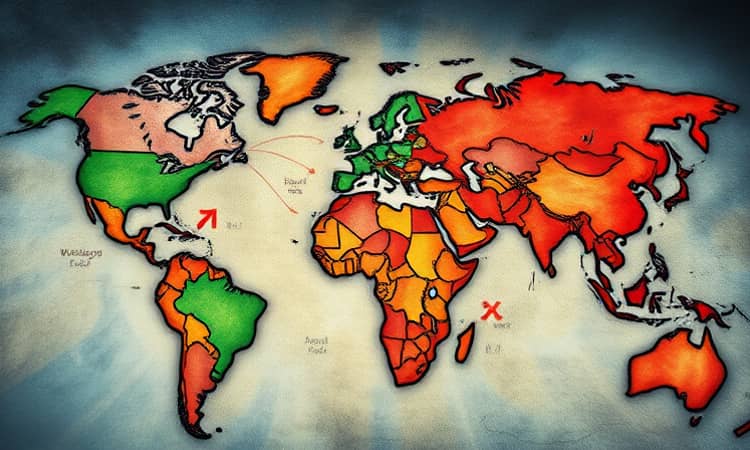
In 2026, investors face a complex web of global tensions and economic shifts. From rising US-China competition to evolving conflicts in Eastern Europe and the Middle East, each political development sends ripples through financial markets. Understanding these dynamics is not just valuable—it's essential to building a resilient investment strategy. This article explores key geopolitical risks, historical patterns of market response, and practical approaches to navigate uncertainty in an era of fracturing world order.
Understanding the Geopolitical Landscape
Geopolitical risk has taken on new dimensions. Once characterized by episodic crises, today’s environment reflects a broader “rupture in the world order,” as leaders at the World Economic Forum have warned. Economic nationalism and a surge in tariff rates have punctured the momentum of globalization, while immigration restrictions constrain labor forces and add inflationary pressures.
Major hotspots warrant close attention. US-China relations remain in a delicate stalemate despite recent diplomatic overtures, while the Ukraine-Russia conflict continues to drive energy price volatility in Europe. Meanwhile, unrest in Iran and shifting alliances in the Middle East create uncertainty around global oil supply and regional stability.
- US-China Strategic Competition: Technology decoupling and supply chain realignment threats.
- Ukraine-Russia Tensions: Disruptions in energy exports and elevated European inflation.
- Middle East Reconfiguration: Iran’s leadership transition and Saudi-Israel normalization.
These developments foster new trade alliances and defense collaborations, reshaping investment landscapes. As the world order fragments, capital allocation must adapt to divergent regional policies and emerging blocs.
Market Responses: Volatility and Beyond
Historically, geopolitical shocks produce a spike in market volatility, but these effects often prove short-lived. Traders react swiftly with sell-offs and buy-the-dip rallies, seeking clarity on immediate supply chain and earnings impacts. Over time, economic fundamentals—corporate profits, monetary stimulus, and fiscal measures—tend to restore upward momentum.
The current backdrop benefits from stealth quantitative easing through mortgage-backed purchases and supportive fiscal policies like the “One Big Beautiful Bill” Act. With the Federal Reserve delivering 75 basis points of rate cuts in 2025 and signaling another 50 basis points in 2026, liquidity conditions remain unusually generous for a mid-cycle market.
Nevertheless, protectionist headwinds and political uncertainties, including potential government shutdowns and looming midterm elections, can amplify market jitters. Divergences across sectors mean that while technology stocks might stall under tariff pressures, defense and commodity-related equities could thrive.
Strategies for Investors in Uncertain Times
Adopting a static portfolio stance can leave investors vulnerable to unforeseen shocks. Instead, consider a dynamic framework that emphasizes scenario planning and tactical flexibility. This approach allows for nimble repositioning as policy shifts and geopolitical events unfold.
- Diversify Across Asset Classes: Combine equities, bonds, and alternative investments.
- Employ Tactical Sector Rotation: Increase exposure to defense, energy, or infrastructure during crises.
- Utilize Hedging Instruments: Options, futures, or volatility products to manage drawdowns.
- Strengthen Regional Diversification: Balance US holdings with emerging and developed market assets.
- Keep Cash Reserves Ready: Retain liquidity for opportunistic entries on market dips.
By implementing these tactics, you can transform market volatility into an opportunity for strategic rebalancing and long-term value creation.
Policy Drivers and Market Uncertainty
Government policy decisions remain pivotal in shaping market trajectories. Investors should closely track an array of political variables that can rapidly shift sentiment and valuations.
- US Midterm Elections: Potential power shifts in Congress and their impact on fiscal policy.
- Tariff Negotiations: Supreme Court rulings and bilateral trade talks with China and Europe.
- Federal Reserve Guidance: Timing and magnitude of rate cuts or hikes.
- Geopolitical Alliances: New defense pacts or trade accords influencing sectoral winners.
Policy uncertainty often leads to increased hedging activity and a higher risk premium embedded in asset prices. Remaining informed about key legislative and regulatory developments can help refine entry and exit points.
Emerging Themes and Long-Term Outlook
Looking beyond immediate volatility, three defining themes will shape investment opportunities and risks in 2026 and beyond: fierce competition between economic powers, the ebb and flow of war and diplomacy, and an overarching climate of uncertainty. Recognizing these long-term trajectories is crucial for positioning portfolios toward resilient growth.
Investors should also consider structurally higher inflation and volatility as part of the new paradigm, allocating to asset classes that historically perform well in such environments, such as real assets and inflation-linked bonds.
Building Resilience and Seizing Growth
While geopolitical events can introduce rapid swings, they often unveil undervalued opportunities. Market dislocations during periods of heightened tension can give astute investors entry points into high-potential sectors or regions before sentiment normalizes.
Start by defining clear risk thresholds and weighing potential upside against downside scenarios. Establish trigger-based rules to adjust allocations, whether that means scaling into defense and energy stocks amid conflict escalation or rotating toward technology and emerging markets during diplomatic thaw.
Remember, informed agility is the investor’s greatest asset. By marrying thorough geopolitical awareness with adaptive portfolio tactics, you can navigate the complexities of 2026, harnessing uncertainty to drive performance rather than impede it. Embrace the challenge, because every market ripple holds the seed of opportunity.