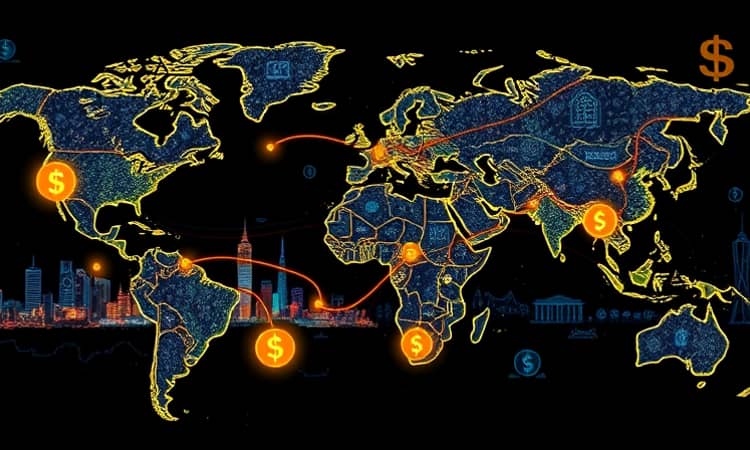
As 2026 unfolds, investors stand at the threshold of a new era where diversification beyond US assets is no longer optional but essential. Global capital flows are being rewired by emerging markets outperformance, de-dollarization trends reshaping global finance, and the rise of tokenized payments. These forces are converging to create unprecedented opportunities—and challenges—for anyone seeking to build a resilient, forward-looking portfolio.
Whether you are a seasoned professional or an individual investor, understanding these major trends will empower you to seize growth prospects, manage risks, and craft a truly comprehensive portfolio diversification strategies beyond borders. In this article, we explore five core narratives driving today’s international investing landscape and provide actionable insights to help you navigate this dynamic environment.
Tokenized Payments and the Fragmentation of Finance
By mid-2026, nearly 75% of G20 nations will have implemented tokenized cross-border payment systems. These digital tokens represent fiat currencies on blockchain networks, enabling faster cheaper international fund transfers and upending traditional correspondent banking. Leading adopters include China, India, Brazil, Russia, and Australia, each forging competing payment corridors that align with regional trade blocs.
This proliferation of tokenized cross-border payments is fracturing the global financial landscape, reducing transaction costs, and accelerating settlement times. For investors, the rise of these digital rails offers new channels for capital deployment and liquidity management, while amplifying the importance of technology infrastructure in emerging markets.
De-Dollarization and Emerging Market Outperformance
A weakening US dollar, driven by prospective Federal Reserve rate cuts, coupled with central banks’ persistent diversification away from US Treasurys, is powering a broad-based rally in emerging markets. As the dollar declines, local currencies appreciate, reducing borrowing costs and boosting corporate profitability across Asia, Latin America, and parts of Eastern Europe.
Emerging market GDP is forecast to rise to 3.9% in 2026, up from 3.7% in 2025, led by Southeast Asia and the Middle East. Valuations remain attractive: EM equities trade at a forward P/E of 14x with a PEG of 0.9x versus the S&P 500. Over the next two years, EM earnings are projected to grow at a 14.9% CAGR compared to 14.5% for US large caps, creating compelling EM valuations and earnings outlook for global portfolios.
Structural Drivers Powering EM Growth
Beyond currency dynamics, several foundational trends are fueling sustainable expansion in frontier and emerging economies. Key catalysts include:
- supply chain diversification and near-shoring initiatives shifting production to Mexico, Indonesia, and Vietnam
- AI and semiconductor capital expenditures in South Korea and Taiwan
- Energy transition and sustainable finance fueling renewables projects
- Digital platforms driving domestic consumption and financial inclusion
Moreover, eight of the ten largest EM sovereigns now boast investment-grade ratings and positive carry yields, offering both income and stability. As global corporates and governments invest in infrastructure, automation, and green energy, these economies are laying the groundwork for decades of structural growth.
Regional Opportunities and Challenges
Global investors are presented with a mosaic of regional stories, each with unique risk-reward profiles. A clear-eyed analysis reveals where to tilt and where to tread carefully.
By combining top-down themes with bottom-up stock and bond selection, investors can target the most attractive sectors in each region while managing country-specific risks.
Broader Global Shifts and the US Context
As advanced economies wrestle with fiscal sustainability and secular headwinds, emerging markets are carving out a larger share of global growth. Key dynamics include:
- weaker US dollar boosting emerging returns
- Fiscal spending in Europe and Japan driving domestic demand
- Innovation in AI, automation, and renewables transcending borders
Structural challenges in the US—rising debt burdens, housing market imbalances, and slowing non-AI sectors—are prompting a rotation of investor capital toward higher-growth, lower-valuation markets abroad. This secular shift offers a potent hedge against domestic political and economic uncertainty.
Risks and Diversification Strategies
Investing internationally comes with its own set of risks. Key concerns include geopolitical tensions, mean-reversion in asset valuations, and fiscal or tariff shocks in emerging economies. Currency volatility can amplify returns but also magnify drawdowns, and technological adoption curves vary widely across markets.
- Geopolitical flashpoints affecting trade routes
- Repricing of tech valuations in high-growth sectors
- Tariff escalations and domestic policy shifts
To build resilience, investors should adopt informed international allocation decisions and implement a disciplined rebalancing framework. Practical steps include: diversifying across regions and asset classes; using currency hedging tools; allocating to tokenized vehicles for efficient access; and partnering with local managers who possess on-the-ground expertise.
Regular monitoring of macro indicators—such as central bank policy, commodity prices, and geopolitical developments—will help anticipate turning points and adjust positioning accordingly.
Conclusion
The landscape of international investing in 2026 is defined by rapid innovation, shifting power dynamics, and the re-emergence of diverse growth engines beyond the United States. By embracing structural themes such as sustainable infrastructure investment in emerging markets, tokenized payment networks, and targeted regional strategies, investors can unlock new sources of return and build truly global portfolios.
Now is the time to step beyond traditional home market biases and seize the transformative potential of de-dollarization, AI-driven capex, and frontier market growth. With careful risk management and a long-term perspective, global money moves can deliver both resilience and performance in the years ahead.