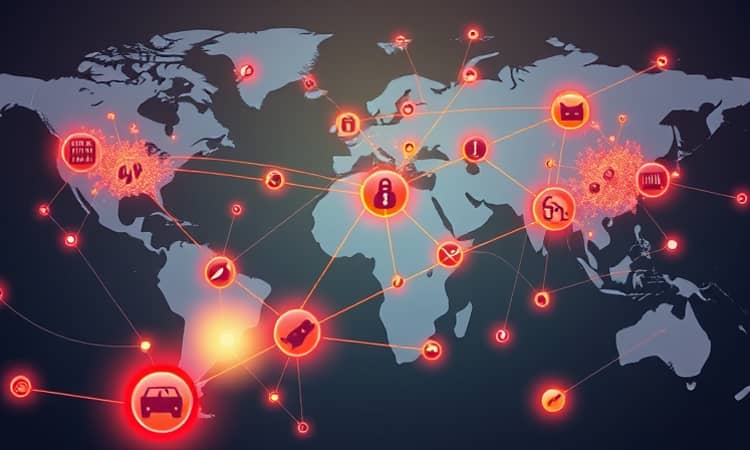
In an era of globalized production and just-in-time operations, the financial health of every link in the chain is critical. Understanding how risks can propagate across suppliers, manufacturers, distributors, and retailers is essential for resilience.
Understanding Supply Chain Solvency
Supply chain solvency refers to the ability of firms across a multi-tier network to meet their financial obligations over the medium and long term. It is typically measured by solvency ratios such as debt-to-equity, interest coverage, and cash-flow-to-debt. These ratios are essentially bankruptcy risk measures for a firm and signal potential vulnerabilities.
Credit risk in the supply chain arises when a supplier or customer fails to pay invoices on time, causing cash-flow strain and possible default. Central to this is trade credit risk—the financing embedded in receivables and payables when firms extend goods or services on credit terms.
Because supply chains form complex networks of firms, distress at one node can ripple throughout the network. This phenomenon—credit risk contagion—occurs when a default or liquidity squeeze at one firm increases the default probability of its trading partners.
The Rising Importance of Interconnected Risk
Over the past two decades, globalization and lean manufacturing have made supply chains longer, more efficient, and inevitably more fragile. When a critical Tier-1 supplier fails, the shockwave can reach Tier-2, Tier-3, and beyond, especially if downstream revenue dependence is concentrated on just one upstream partner.
Operational disruptions—such as delayed shipments or component shortages—often morph into credit problems. As buyers idle production, inventories pile up, and working capital cycles extend, revenue drops and solvency metrics deteriorate.
Consider a network study of over 240,000 firms, 27 banks, and 1.1 million supply-chain links in Hungary: it found that ignoring supply-chain contagion could lead banks to underestimate realized credit losses by up to five times compared to traditional single-firm models.
Mechanisms of Credit Risk Contagion
Trade credit is the most widely used financing channel in supply chains. If supplier Si defaults on payments, creditor Sj immediately faces a loss on receivables and must absorb the shock.
- Payment defaults on trade credit reduce receivables for upstream firms and force buyers into expensive spot purchases.
- Liquidity and working capital stress emerge when distressed partners delay payments or tighten credit terms.
- Production halts and lost sales occur when missed deliveries idle downstream operations.
Multi-tier dependencies amplify these effects: a Tier-2 supplier heavily reliant on a single Tier-1 partner may collapse if that partner weakens. Likewise, banks exposed to borrower credit risk must account for the network effects of their customers’ supply chains, or risk significant underestimation of systemic losses.
Case Studies: When Contagion Strikes
Reward Group, a Chinese commodities and real estate conglomerate, filed for bankruptcy reorganization in 2019 with RMB 6.094 billion of debt. Its default on accounts payable swiftly pushed key trading partners into financial distress, illustrating how one large node can trigger supply chain credit contagion.
In the Netherlands, the 2015 bankruptcy of department-store chain V&D imperiled hundreds of suppliers and several banks. The failure spread through contractual links, revealing hidden systemic risk within a national supply network.
In a corporate example, a global consumer-goods manufacturer identified financial instability among critical overseas suppliers. By implementing automating real‐time credit alerts, conducting regular liquidity checks, and proactive diversification of supplier base, it reduced late-payment issues by 30% and avoided approximately $250,000 in potential downtime costs.
Implications for Corporate Credit Ratings
Supply chain vulnerabilities directly affect issuer credit quality. Disruptions can damage EBITDA, leverage, and cash-flow metrics that drive rating decisions. After the 2020–2022 bottlenecks, S&P Global Ratings took over 200 negative rating actions due to supply-chain events, underscoring the link between operational hiccups and credit outcomes.
Economic, financial, and operational risks—including market volatility, supplier financial instability, and labor shortages—are increasingly central to credit assessments across industries, particularly automotive, retail, and technology.
Quantitative Tools to Assess Solvency
Evaluating supply chain solvency requires both firm-level metrics and network-based models. Key ratios include:
Beyond ratios, firms should track operational performance, governance quality, and macro factors such as economic cycles and foreign exchange risks. Graph-theoretic models distinguish own credit risk from trade credit risk contagion, mapping exposures along directed edges and simulating default cascades.
Strategies to Mitigate Supply Chain Credit Risk
Organizations can build resilience by adopting a multi-pronged approach:
- Implement continuous credit monitoring of all critical suppliers, using automated alerts to flag deteriorating metrics.
- Diversify supplier networks to reduce dependency on single points of failure.
- Collaborate cross-functionally—finance, procurement, and operations—to align risk thresholds and response plans.
- Leverage scenario modeling to forecast the impact of partner distress on working capital and production continuity.
- Consider credit insurance or supply chain finance solutions to buffer liquidity shocks.
Proactive engagement with banks and regulators can also improve transparency and support tailored credit models that account for network contagion. By incorporating supply-chain linkages into risk assessments, lenders can more accurately price loans and allocate capital.
Ultimately, safeguarding supply chain solvency is not just about financial ratios or individual firms. It requires a systemic perspective, continuous monitoring, and collaborative risk management. With the right tools and strategies, organizations can transform their supply networks from potential contagion sources into pillars of competitive advantage and resilience.