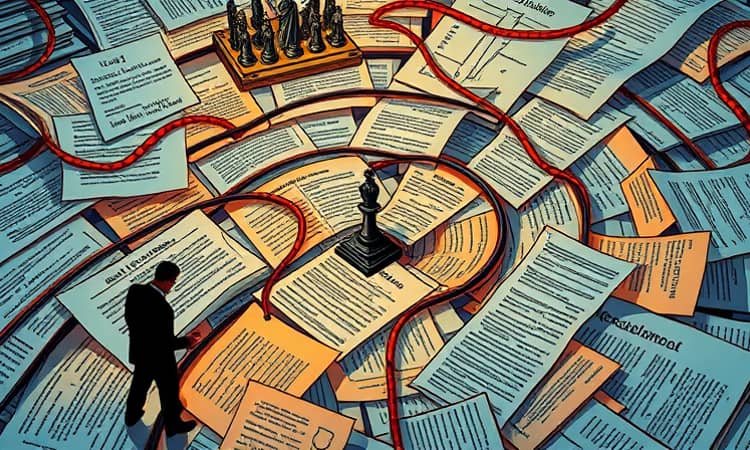
In today’s intricate financial world, contracts often stretch into tens of thousands of words, weaving an elaborate tapestry of rights, obligations, and exceptions. While each clause aims to align interests, the sheer length and complexity can obscure unforeseen pathways that savvy parties exploit.
This article delves into how lenders craft safeguards, why unintended loopholes emerge, and real-world lessons from landmark cases. We conclude with practical guidance for drafting robust agreements that stand the test of time.
Understanding Legal Loopholes in Lending
A gap or ambiguity in contracts arises when the written text leaves room for interpretations its authors never foresaw. In lending agreements, these loopholes commonly hide amid definitions, carve-outs and cross-references that interact in surprising ways.
- Ambiguous or outdated language allowing unexpected asset transfers
- Overly narrow regulatory coverage creating enforcement blind spots
- Complex drafting with many cross-references and carve-outs
Each exception, innocuous in isolation, may combine with others to form a covert route for value leakage, undermining the lender’s position.
Contractual Protections: Safeguarding Lenders’ Interests
To counteract risk, lenders embed a suite of protective mechanisms in credit agreements. These provisions seek to preserve collateral and security interests, limit borrower actions and provide clear remedies upon default.
- Collateral packages secured by real assets, intellectual property, and receivables
- Negative covenants restricting additional debt, asset sales or liens
- Events of default triggering acceleration and enforcement rights
- Guaranties and structural protections across subsidiaries
Well-drafted covenants align borrower behavior with lender expectations and protect recovery priority during distress.
Case Study: The J. Crew “Trap Door” Transaction
In 2014, J. Crew renegotiated a $1.5 billion term loan that spanned roughly 87,000 words. Despite extensive restrictions on transferring collateral, advisers unearthed a “trap door” in the investments covenant.
They combined two carve-outs: one permitting up to $150 million of investments in a restricted subsidiary, and another allowing that entity to fund an unrestricted subsidiary without limit. The result: about $250 million of trademark collateral shifted outside the senior lenders’ package and pledged to new junior creditors.
This maneuver, intended for overseas ventures, became a template for restructurings at Neiman Marcus, PetSmart and Cirque du Soleil, illustrating how unanticipated pathway for value transfer can arise from innocent-looking exceptions.
Why Complexity Breeds Loopholes
Research shows that bounded rationality and human oversight limit the capacity of parties to foresee every interaction within voluminous documents. Negotiators rely on market templates, layering bespoke changes that may not integrate logically.
Carve-outs erode core protections step by step, offering a series of “except for…” clauses that look harmless until combined. As each exception accumulates, the risk of an exploitable gap grows exponentially.
Beyond Commercial Finance: Consumer Contracts and Policy Gaps
Contract loopholes are not confined to high-finance. The U.S. Consumer Financial Protection Bureau warns of deceptive fine-print in consumer agreements that attempt to waive non-waivable rights.
- Mortgage clauses purporting to limit statutory loss-mitigation rights
- Bank account agreements claiming to bar liability for garnishment errors
- Auto loan contracts suggesting consumers cannot exercise bankruptcy rights
While commercial loopholes exploit ambiguous carve-outs, these consumer-facing traps cross into illegality. Here, regulatory enforcement as a backstop becomes essential to protect fundamental borrower rights.
Closing the Gaps: Best Practices and Forward-Looking Drafting
To fortify agreements against future exploits, lenders and counsel should adopt proactive strategies:
- Tighten definitions of “restricted” and “unrestricted” subsidiaries
- Impose absolute prohibitions on transfers of key intellectual property
- Include “blocker” provisions preventing collateral migrations
Additionally, continuous monitoring of market developments and emerging loopholes helps drafters anticipate new tactics rather than merely patch past holes.
In an ever-evolving lending landscape, the most effective protection lies in clear, comprehensive drafting and rigorous due diligence. By understanding the anatomy of loopholes and employing tight constraints on unrestricted subsidiaries, practitioners can create agreements that remain sound against both known and unforeseen challenges.
Ultimately, robust contractual frameworks not only safeguard lenders’ recoveries but also foster transparency and trust between parties. A well-crafted agreement transforms from a static document into a living instrument that guides responsible financing and upholds the integrity of the credit markets.